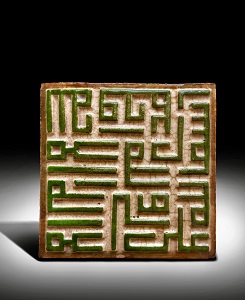
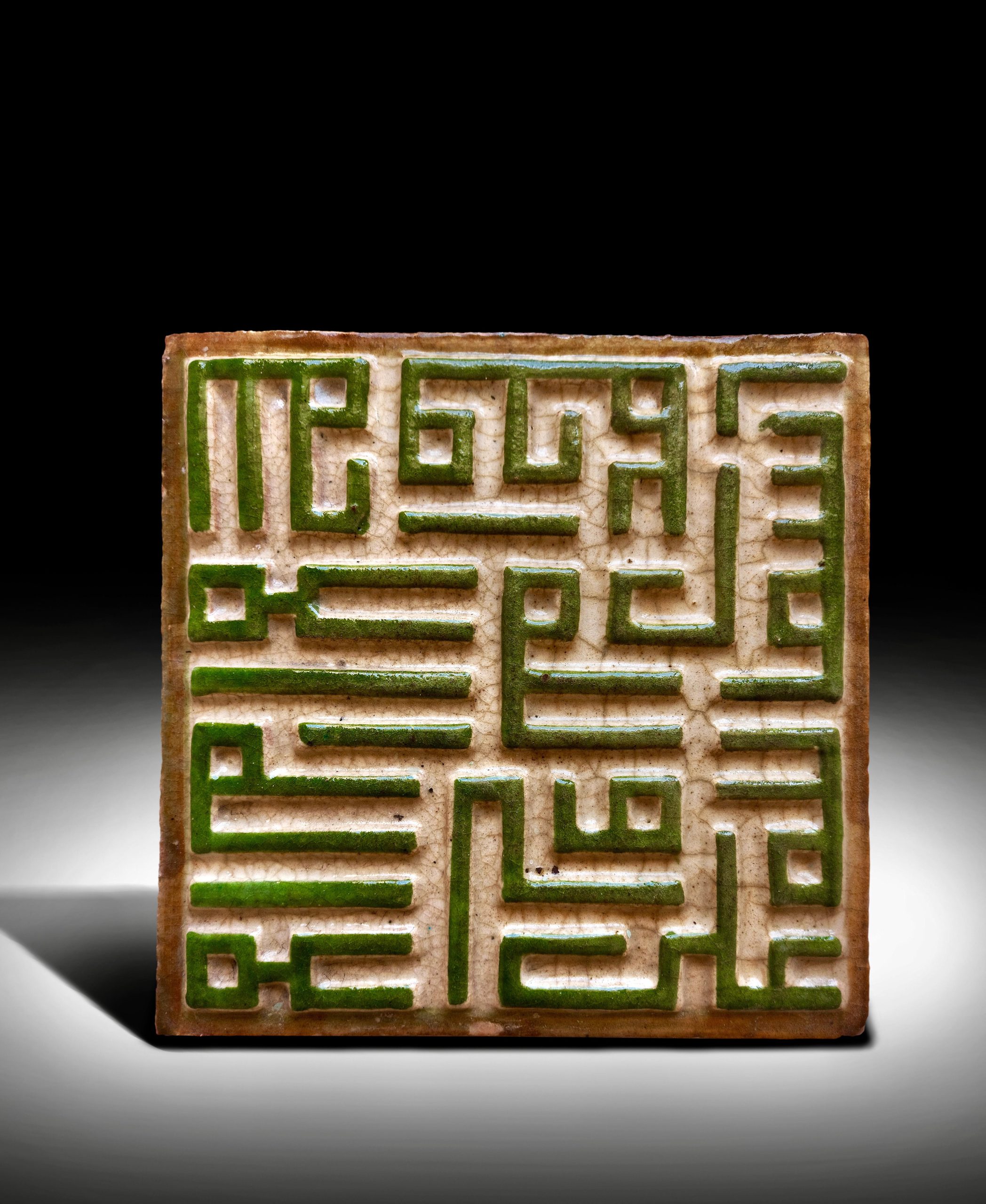
DESCRIPTION: | The inscription comprises geometric calligraphic in square Kufic. The tile is inscribed with the names of Allah, the Prophet Muhammad, and his son-in-law and successor Ali in square “Kufic script”.The earliest extant example of square kufic to survive is on a minaret erected in Ghazna by the Ghanznavid ruler Mas’ud III (R.AD 1098-1115) Most inscriptions of this type contain sacred names or short pious phrases of a general nature tile inscriptions in square kufic were especially popular in Persia during the 13th and 14th Centuries because of its similarity to Phagspa introduced in AD 1269 by the Yuan ruler. Particularly on insignia and seals,these seals were distributed to the Ilkhanids.Narratives:Blair Islamic Inscriptions,
Edinburgh, 1998, PP. 82-88. |
|---|
FOOTNOTE: | Ref: Tiles such as the original ones are known to have been placed in combination with others on the west iwan in the Ghiyathiyya Madrasa, Khargird (Lentz, Thomas W., and Glenn D. Lowry: Timur and the Princely Vision Persian Art and Culture in the Fifteenth Century, Los Angeles, 1989, p.90 and p.333). One-half tile remains in situ in the entrance hall (Golombek, L and Wilber, D: The Timurid Architecture of Iran and Turan, Princeton, 1988, II, pl.233). This building was finished in 846/1442-43 for Ghiyath al-Din Pir Ahmad Khvafi, one of the viziers of the Timurid Shah Rukh. The building was begun by the architect Qavam al-Din Shirazi who died in 1438, and was then completed by Ghiyath al-Din Shirazi. Identical tiles can be found in the David Collection (Folsach, Kjeld von.: Art from the World of Islam in the David Collection, Copenhagen, 2001, pl.226, p.174), in the Metropolitan Museum of Art, New York, (Carboni, Stefano and Masuya, Tomoko: Persian Tiles, New York, 1993, no.34, p.39, the note to which discusses further details and examples), and the British Museum (Porter, Venetia: Islamic Tiles, London, 1995, pl.63, p.69), amongst several others in public and private collections. Another ten-pointed tile with this exact design was on sale at Sotheby’s, London, Sale L01281, Lot 116, 2001. (result unknown) A similar but twelve-pointed tile of this type sold at Christie’s London, Sale 6895, 2004, Lot 204. (GBP 35,850)” |
|---|