PERIOD: | Mid 20th Century |
|---|
ORIGIN: | PROBABLY DIYARBAKIR, EASTERN TURKEY |
|---|
DIMENSIONS: | Approx; Ewer (33cm.) high; basin (18cm.)Plate (28.2cm.) diam |
|---|
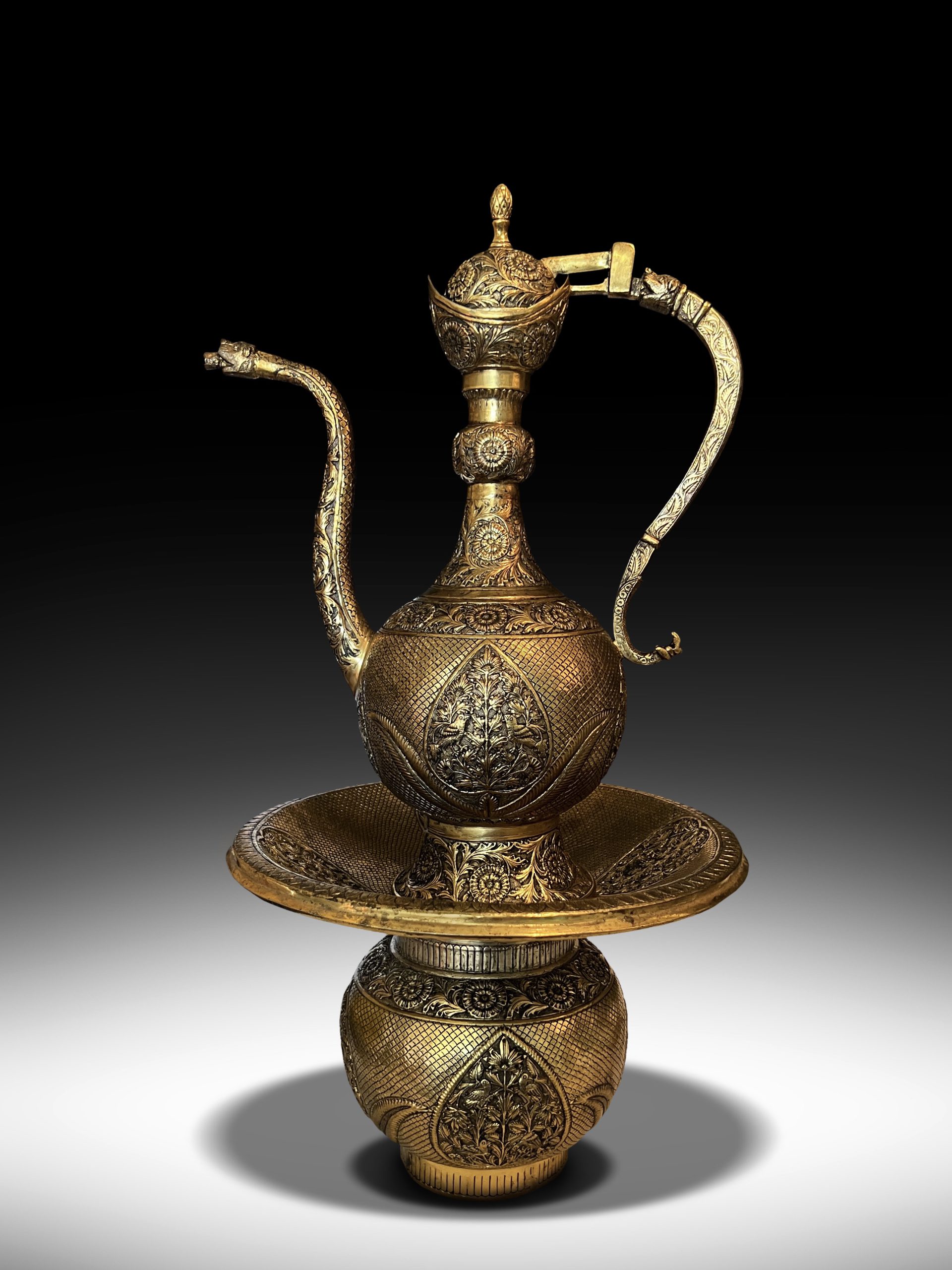
DESCRIPTION: | An exceptional set brass “Tombak ewer with a rounded body, on a short splayed foot, with a slightly waisted neck, slender curving lion spout and applied with the lion open mouth strap handle, exquisite domed lid with knop finial, the body decorated with birds-scale motifs regularly interrupted with roundels and a a couple of birds glimpsing at each other containing reciprocal design, the neck and foot with engraved foliate motif, all with applied circular bosses set with the basin of rounded form with everted rim and separate pierced inner cover with raised stand, the rim with foliate motifs set at regular intervals with bosses, the inner cover similarly set, slight losses of, handle detached at the body. |
|---|
Condition Report: | The basin and filter appear to be made as a set, the ewer appears to be a later marriage/association from a different set as it does not sit on the filter as it should be fitted, the gilding rubbed and with some light scratches to surface, minor dents to each component as consistent with age and use, as viewed. |
|---|
Lot Essay: | A very similar ewer and basin, although with considerably less well preserved gilding, was sold in these Rooms 23 October 2007, lot 116. For a further similar ewer see Sotheby’s London, 18 April 2007, lot 194. There they note another example, although re-gilded, which is on display at the Wallace Collection in London. The form and decoration are based on a very similar form demonstrated by one in the museum of Turkish and Islamic Art, Istanbul (The Anatolian Civilisations exhibition catalogue, Istanbul, 1983, vol.II, no.E.283, p.273), while a further example is in the Ethnological Museum in Berlin (Jens Kröger and Désirée Haider, Islamischer Kunst in berliner Sammlungen, Berlin, 2004, no.59, p.78). Most interesting is an example in Milan where the enamelling on the ewer is applied directly to the body, but that on the basin is in roundels as here. That ewer also bears the crudely engraved ownership tughra of Fatima Sultan Khan and the date AH 1120/1708-9 AD (Museo Poldi Pezzoli, Tessuti-Sculture – Metalli Islamici, Milan, 1987, cat.no.11, pp.279-280 and pls.23-25, pp.302-3). |
|---|
PROVENANCE: | From a distinguished collector in Monaco in Europe |
|---|
CERTIFICATE: | Comes with a certificate from the Art Loss Register |
|---|