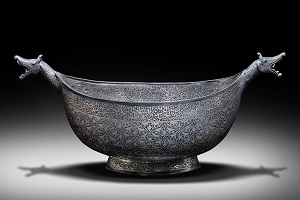
DESCRIPTION: | Of typical an aperture form, the ends rising to two pronounced snarling dragon-head terminals, the body engraved with two bands of cusped arabesque medallions divided by bands of floral interlace and cusped arabesques, a wide band around the mouth of elegant “Qur’ainc inscriptions” cartouches on a hatched ground, a band of inscriptions within the interior and around the rim, of alternating cusped arabesque roundels alternating with similar cartouches forming a border around similar motifs and scattered arabesque in the centre, very slightly rubbed, the hatched grounds with patina composition. |
|---|