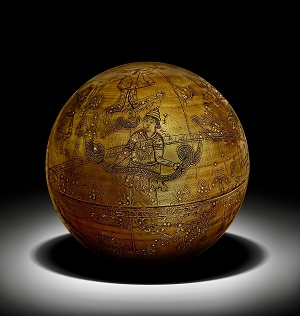
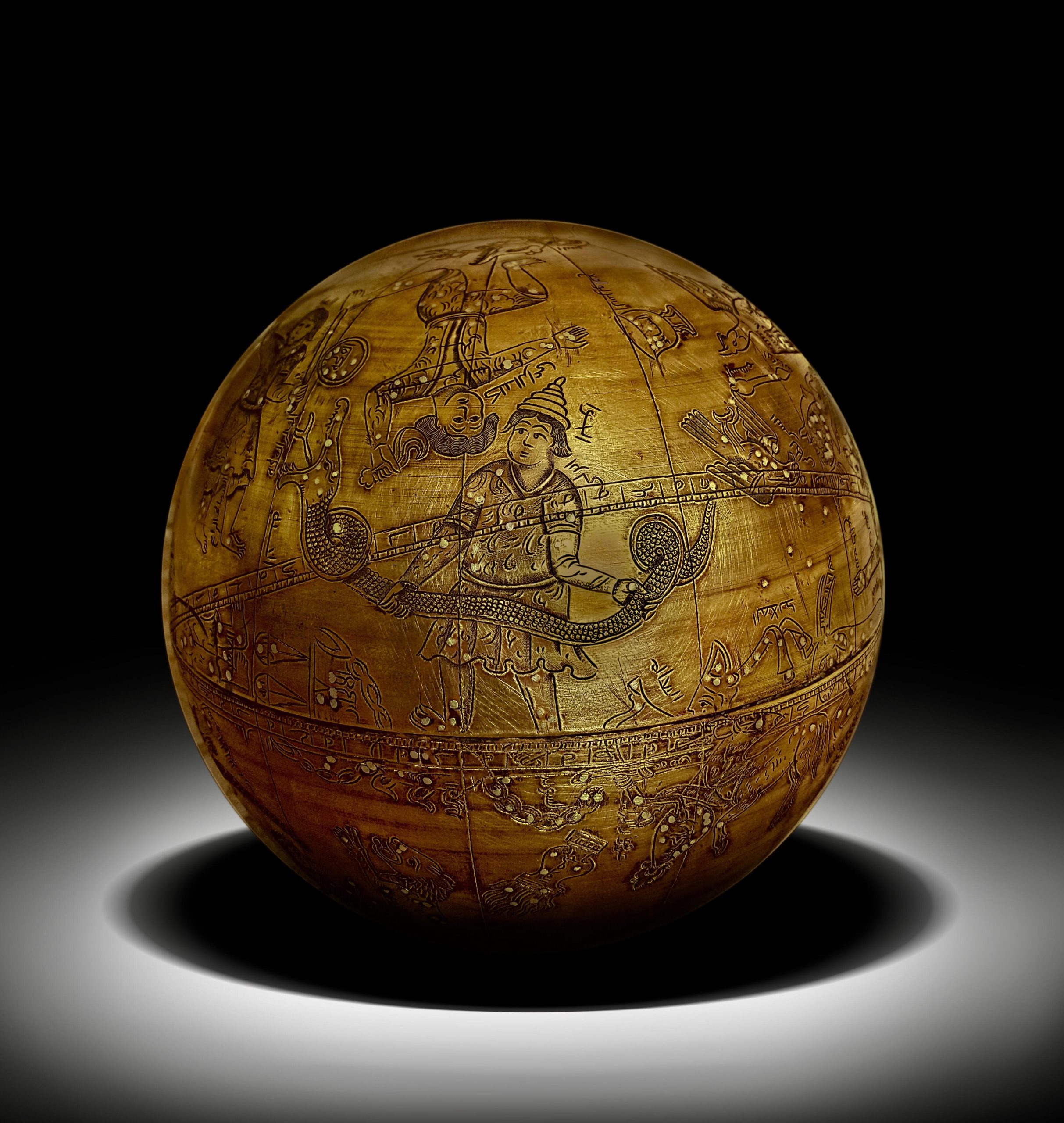
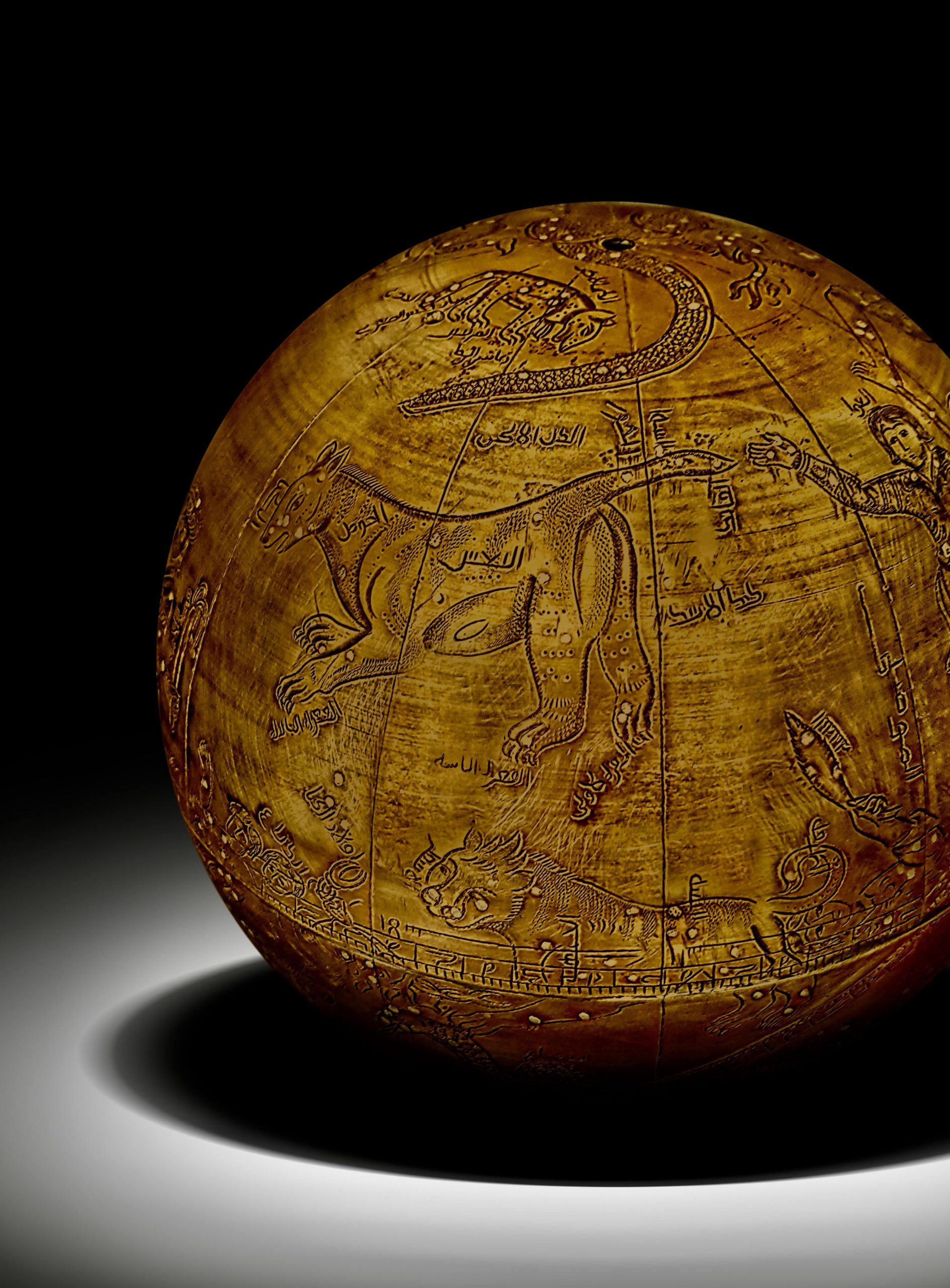
DESCRIPTION: | The celestial globe with the noticeable sliver Inlaid stars with the constellations and inscribed with their names in Arabic; engraved with the name of the maker Al-Mawsili (‘The Astrologer from Mosul’)is a three-dimensional map of the stars and has been used since classical times. The stars were thought to sit on the surface of a giant sphere around the Earth, and the constant movement of the stars every night and throughout the year seemed to be caused by this giant sphere slowly turning overhead. Just like a terrestrial globe, the celestial sphere is mapped by a North and south pole, and the Equator, and lines of longitude and latitude. Celestial globes were produced first by Greek astronomers, and later also in the Islamic world, where the earliest known globes date from the late eleventh century. Islamic astronomers built upon many of the achievements of classical Greek science, further refining concepts and the design of astronomical instruments, such as the celestial globe and the astrolabe. This is why an Islamic globe depicts the classical constellations, such as the Great Bear, Pegasus, Orion and the twelve signs of the zodiac. At the South Pole of this globe, the craftsman has inscribed his signature: ‘Made by the most humble in the supreme God, Muhammad ibn Hilal, the astronomer from Mosul, in the year 674’ (AD 1275-76). Mosul is an important city in northern Iraq, famous in the first half of the thirteenth century for its skilled metalworkers.In the Islamic world, the globe was first made as two shallow hemispheres which were then joined together, the line of joint being marked as the celestial equator.NOTWITHSTANDING ANY DISCUSSIONS CONCERNING THIS OBJECT, AND ALL LOTS ARE OFFERED AND SOLD AS IS BY THE BUSINESS PRINTED IN THE SALE TERMS AND CONDITIONS. |
|---|