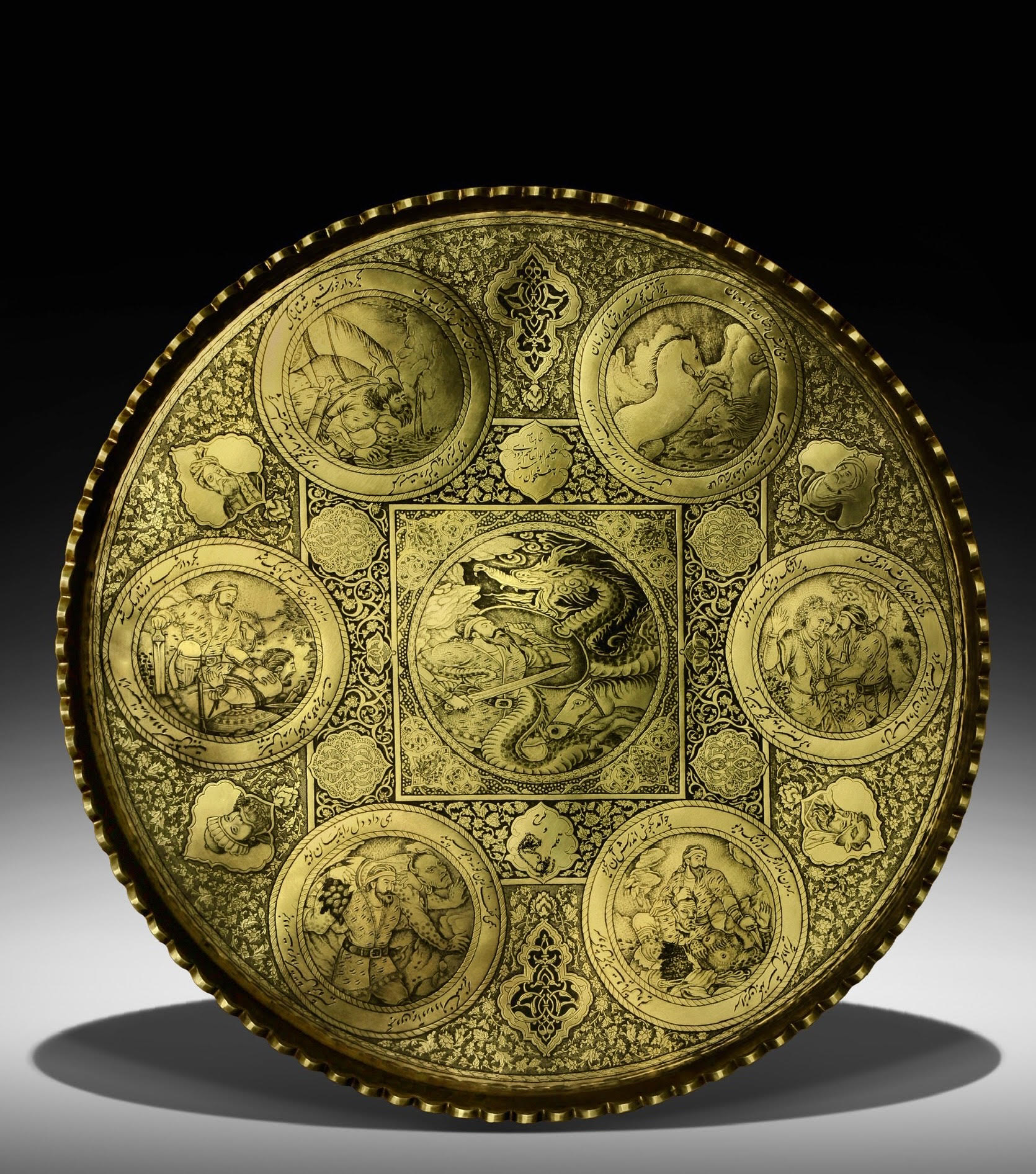
DESCRIPTION: | Exceptionally rare engraved Persian brass trays with the utmost intricacy attributed to the artists with the intersections band of the famous epic of (The Seven Labors of Rustam)tail in the centre it commencing with the drawn sword as added the surrounding each epic Circular rounded by its novel tails.The depths margin and epicentre are Surrounded by a band of intertwined arabesques, an outer plain band containing roundels with Persian Gardens motifs.The Epic is as follows:
The Seven Labors of Rustam (Persian Romanized (Haftkhān-e-Rostam) were a series of acts carried out by the greatest of the Iranian heroes, Rostam;
The story was retold by Ferdowsi in his epic poem, Shahnameh; known as; The Seven Labours were seven difficult tasks undertaken by Rostam, accompanied, in most instances, only by his faithful and sagacious steed Rakhsh although in two labours he was accompanied also by the champion, Olad.The Haftkhān
According to the traditional narrative, the story starts when Kay Kavuos’s expedition to Mazandaran fails, and his army is captured by the Divs, Rostam undertakes to liberate it and achieves his goal by performing the labours. The traditional order of the seven is as follows:The First Labour:
Rostam falls asleep among the reeds.
After a short time, a fierce lion appears, and mounts a ferocious attack on his horse Rakhsh; but Rakhsh, although hard-pressed, succeeds in killing the savage beast with his teeth and hooves. Rostam, awakened by the tumult, and seeing the dead lion and the wounded Rakhsh before him, make haste to heal his beloved steed, before remounting him and continuing on his way toward Mazanderan.The Second Labour:
Rostam enters a desert, in which no water is to be found. Both horse and rider become oppressed by thirst and therefore, Rostam prays to God. Sweltering under the burning sun, Rostam sees a sheep pass by, which he hails as the harbinger of good. Rising and grasping his sword in his hand, he follows the animal and comes to a fountain of water, where he devoutly returns thanks to God for the blessing which has preserved his existence.The Third Labour:
Rostam Slaying the Dragon,
by Adel Adili
At midnight a monstrous serpentine dragon emerges from the forest; Rakhsh approaches his sleeping master and neighs and beats the ground so furiously, that he succeeds in waking him. Rostam looks around, but, seeing nothing, because the dragon has already vanished, grumbles and goes back to sleep. The dragon appears a second time and once again the faithful horse succeeds in rousing his master. Rostam is even angrier than before, but at this moment sufficient light is providentially given to him to allow him to see the monster that has been causing Rakhsh such alarm. Rostam then slays the dragon.The Fourth Labour:
Rostam, back in the saddle once more, continues his journey through enchanted lands, and comes, in the evening, to a beautiful glade refreshed by limpid streams, where he finds, much to his surprise, a ready-roasted deer, together with the bread and salt to accompany it. He sits down at the mysterious banquet, but it vanishes at the sound of his voice. Next, he sees a tanbur and a flask of wine: taking up the instrument, he plays upon it, improvising a ditty about his wanderings, and the kinds of an exploit which he loves best. The song reaches the ears of the alluring sorceress responsible for the fairy banquet, who suddenly appears and sits down at his side. Rostam offers up a prayer of thanks for having been supplied with food, wine, and music in so inhospitable a place as the desert of Mazanderan, and, not realising that the enchantress is, in fact, a demon in disguise, he places in her hands a cup of wine in the name of God; but, at the mention of the Creator, the temptress is forced to resume her true form – that of a black fiend. Seeing this, Rostam holds her fast with his lasso, before drawing his sword and cleaving her in two.
This labour bears a marked resemblance to an episode involving the temptation of sir Percival in the Grail quest section of the thirteenth-century Arthurian text known as the Vulgate cycle and also as the Lancelot Grail.This resemblance may be due to the borrowing of material from the Persian text into the European. Such borrowings have been detected before in certain Arthurian romances.The Fifth Labour:
by Mohammadreza Ghorbani
Rostam conquers the Mazandarani champion (Olad Deev) who describes the caves of the demons.The Sixth Labour:
Rostam enters the city of Mazanderan, releases Shah Kai Kavus – still blind from the sorcery of the demons – and slays Arzhang Div.The Seventh Labour:
Rostam fight Div-e-Sepid
Rostam overthrows and kills Div-e-Sepid, the White Demon The blood of the White Demon’s heart restores Kai Kavus’s sight. Rostam also kills the magician king of Mazandaran not to be confused with Mazandaran Province and returns to Estakhr accompanied by the Shah. |
|---|