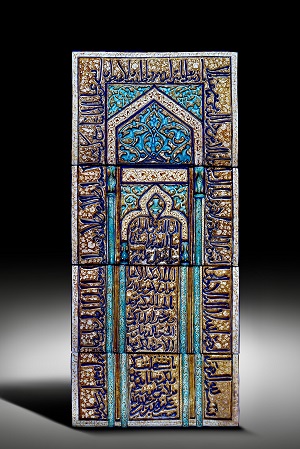
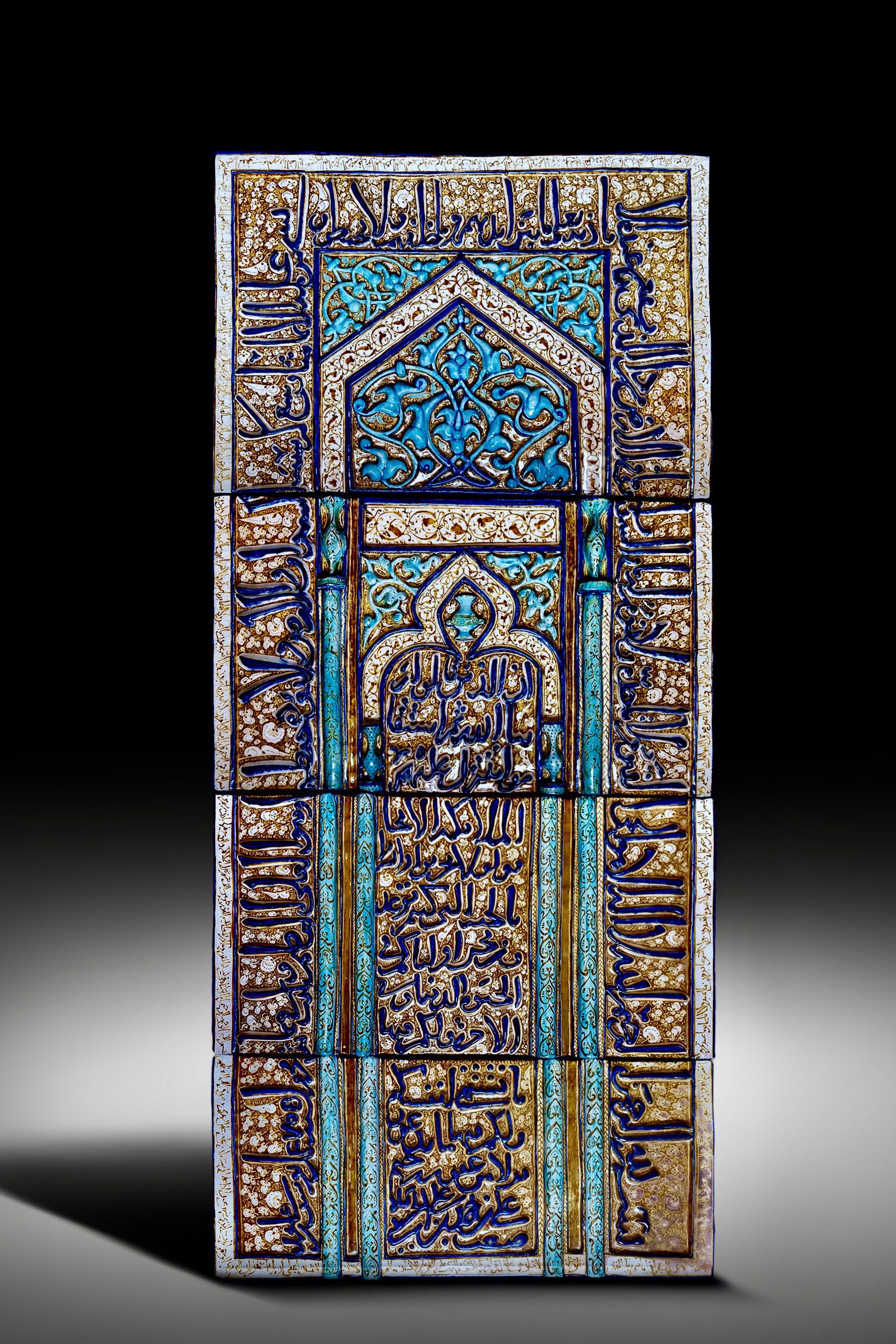
Lot Essay: | Inscriptions
In the borders: Qur’an, chapter
Ayat-Al Kursi
The Throne Verse in the Qu’ran
Throne Verse of the
( II CCXXV).Dated,700 Hijri
Commemorated to the Master Artisans Name:
Ibn Saeed Ali MuhammadSure XLI : FUSSILAT (EXPLAINED IN DETAIL) -Verse’XXIV-Translation Qarib Search Recite.إِنَّالَّذِينَقَالُوارَبُّنَااللَّهُثُمَّاسْتَقَامُواتَتَنَزَّلُعَلَيْهِمُالْمَلَائِكَةُأَلَّاتَخَافُواوَلَاتَحْزَنُواوَأَبْشِرُوابِالْجَنَّةِالَّتِيكُنْتُمْتُوعَدُونَ﴿۳۰﴾
The angels will descend on those who said: ‘Allah is Our Lord, ‘ and have then gone straight, (saying:) ‘Be neither fearful, nor sad; rejoice in the Paradise you have been promised. (30) نَحْنُأَوْلِيَاؤُكُمْفِيالْحَيَاةِالدُّنْيَاوَفِيالْآخِرَةِوَلَكُمْفِيهَامَاتَشْتَهِيأَنْفُسُكُمْوَلَكُمْفِيهَامَاتَدَّعُونَ﴿۳۱﴾
We are your guides in this world and in the Everlasting Life. There, you shall have all that your souls desire, and all that you ask for (31) نُزُلًامِنْغَفُورٍرَحِيمٍ﴿۳۲﴾ as hospitality from One, the Forgiving, the Most Merciful. ‘ (32)
وَمَنْأَحْسَنُقَوْلًامِمَّنْدَعَاإِلَىاللَّهِوَعَمِلَصَالِحًاوَقَالَإِنَّنِيمِنَالْمُسْلِمِينَFootnote:
Following the devastating invasion of the Mongol hordes in the 1220s, the ceramic industry in Persia declined momentarily, only to be revived by a fresh approach and innovative design vocabulary. The use of lustre plays a prominent role in this expansion, and huge complexes, with monumental mihrab shrines were built, combining cobalt-blue, turquoise and honey-lustre tiles. Notable examples include the mihrab from the shrine at Mashhad, dated 640 AH/1242 AD (now in the Shrine Museum, Mashhad), the mihrab from the dated 667-670 AH/1268-71 AD.Kashan mihrabs of this period are particularly impressive due to their size, variance in thickness and the unstable nature of the firing process at this time with pieces of this size. The even lustre that can be seen on this tile is particularly remarkable given the difficulties in controlling the passage of air throughout the kiln. The present example would have probably formed part of a central section from a larger mihrab panel as cited above. Two close comparables are in the Victoria and Albert Museum, London, inv. no. C.1977-1910, and the Metropolitan Museum of Art, New York (inv. no.09.87), both which include stylised mosque lamps as part of their design, echoing their close relationship with light, through the medium of lustre and their function as propagators of the Divine word. |
|---|