


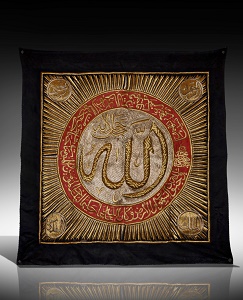
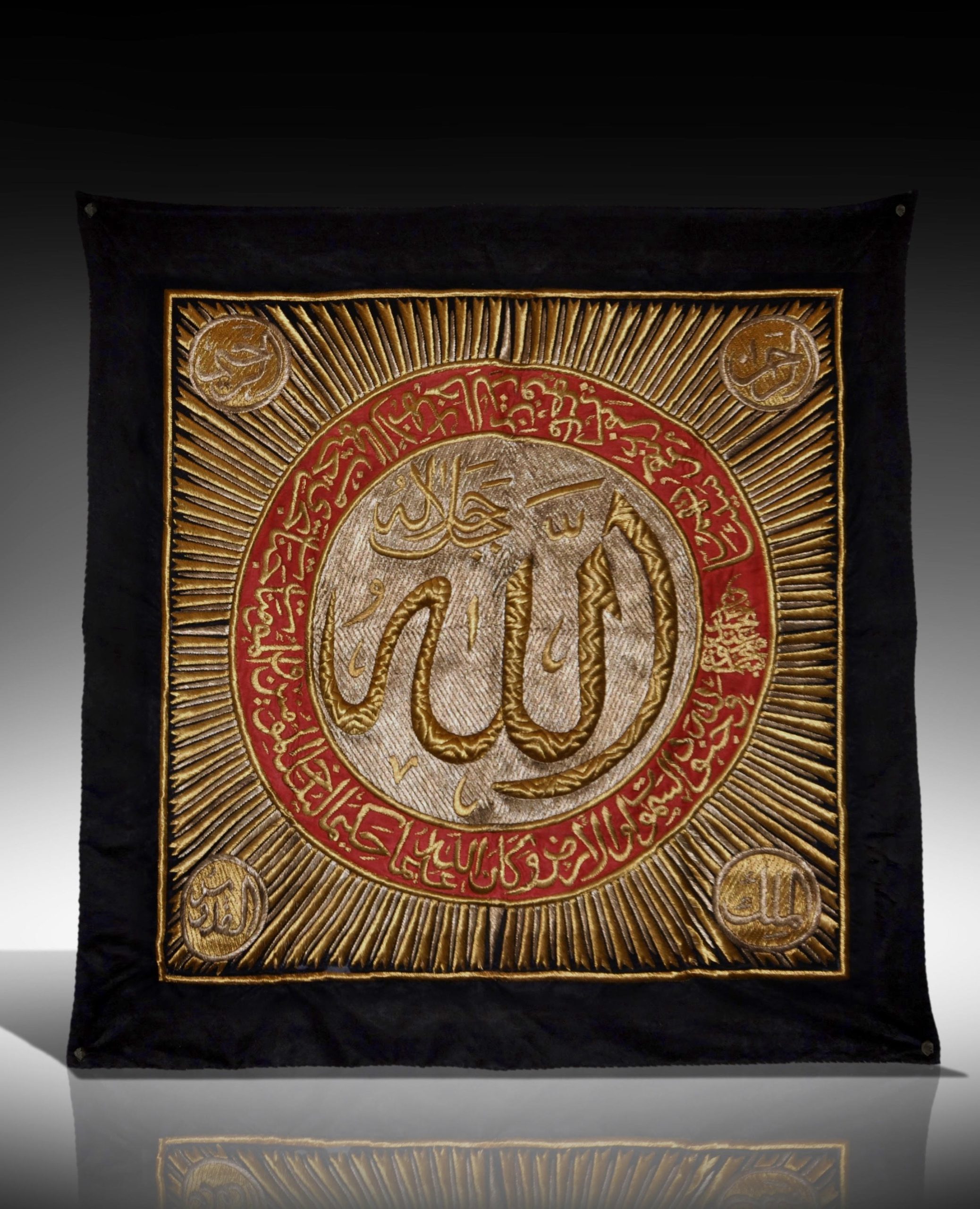
A LARGE METAL ISLAMIC THREAD EMBROIDERED TEXTILE PANEL WITH RAYS IN THE CENTER THE NAME OF “ALLAH”
| PERIOD: | 18th Century |
|---|---|
| ORIGIN: | Egypt |
| DIMENSIONS: | Hight 135 X Width 128 Cm |
| DESCRIPTION: | Of square form, In an Arabic -Burst Sun-form cresting emitting rays in the centre the name of “ALLAH” with the rich gold embroidered on black silk within the radial composition and the spandrels of gold silk with gold rays between black bands. |
| Lot Essay: | The inscription In the centre is the name of “ALLAH” made with the rich gold embroidered on black aground in the (XVIII period) in Suadi Arabia. The tradition of covering the Ka’ba with textiles is said to go back to the pre-Islamic period. As early as 400 AD was the Ka’ba covered with luxurious cloth from Yemen (Venetian Porter, ed., Hajj, Journey to the heart of Islam, London, 2012, p.257). Following the death of the Prophet Muhammad in 632 AD, providing the cloth of the Ka’ba became the prerogative of the ruler. The Caliphs ‘Umar, Mu’awiya and al-Ma’mun, Sultan al-Nasir Qalawun, Sulayman the Magnificent and Muhammad ‘Ali Pasha, all are recorded to have doted the Ka’ba with the most expensive textiles. Traditionally the textiles for the Ka’ba and the holy shrines were made in Egypt. Some coverings where also made in Yemen, in Iran or in Istanbul (at the Hereke factory for instance). Opened by Muhammad ‘Ali in 1817, the Kharanfash factory in Egypt stopped producing the kiswa when King ‘Abd al-‘Aziz of Saudi Arabia open a factory in Mecca in 1927. Textiles for the Holy Shrines include the kiswa (robe) of the Ka’ba, the ham (belt) and the Sitara (door). Whilst the kiswa, hizam and sitara were renewed every year, the interior textiles of the Ka’ba, characterized by their zigzag patterns on green or red ground were changed once per reign. The Ottoman sultan Selim I decreted that these should be made in Istanbul. They could also be used for the Tomb of the Prophet in Medina, in which case their calligraphic decoration would be different. The Banu Shayba is the family in charge of the renewal of the kiswa since the time of the Prophet Muhammad. They also hold the keys to the Ka’ba. Once the kiswa, belt and interiors textiles were replaced, the Banu Sha’ba were in charge of cutting them up and dispose of them. Particular sections were reserved, for example for the Sharif of Mecca or other dignitaries, but they were also able to sell other pieces in special shops near Bab al-salam (Venetia Porter, ed., op.cit., p.265). |
| PROVENANCE: | From Distinguished Collections |
| CERTIFICATE: | Comes with a certificate from the Art Loss Register |
