


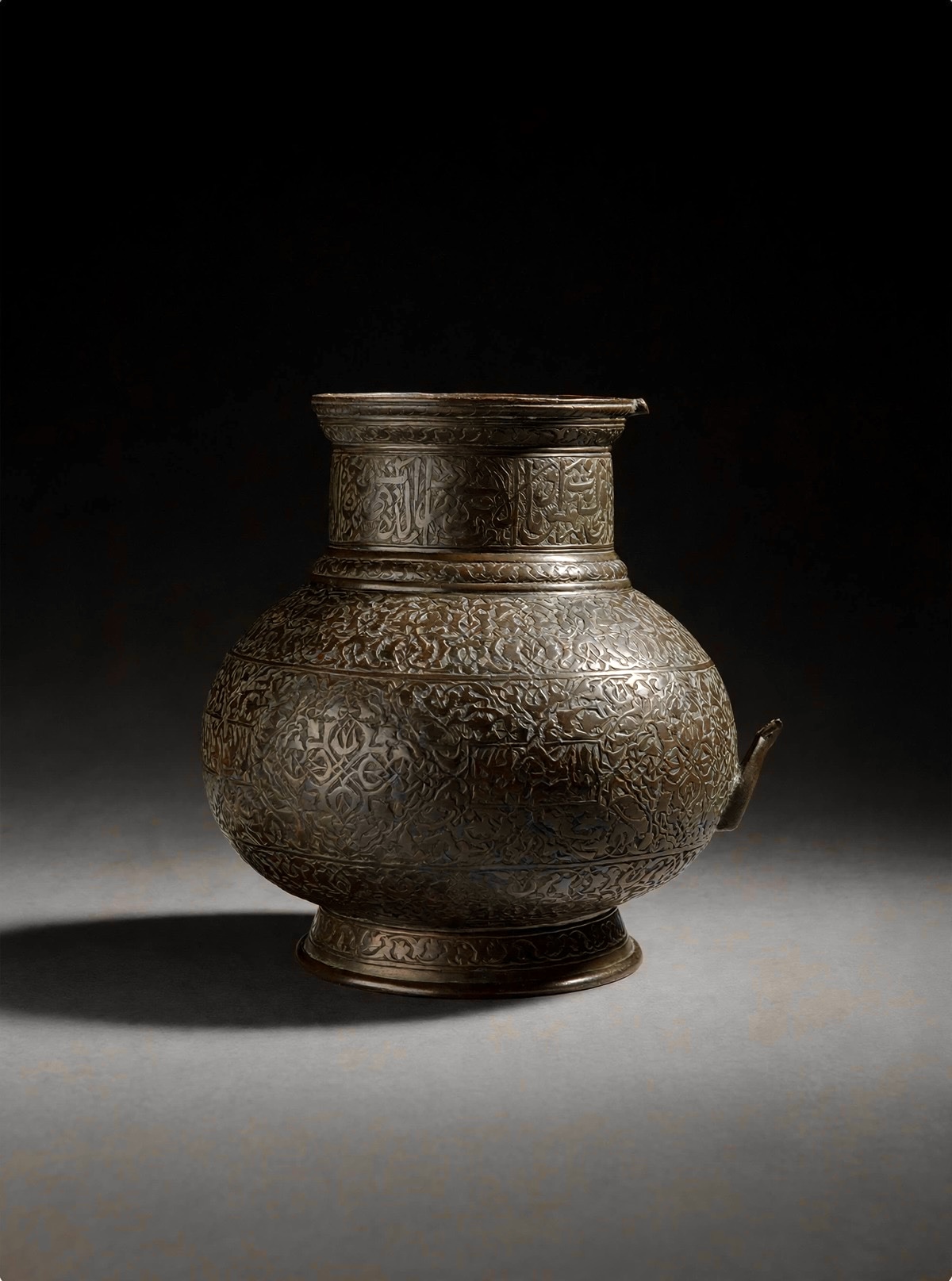
A TIMURID HEAVYSET-COPPER JUG KNOWN AS (MASHRABEH)
PERIOD :
15th/16the Centuery
ORIGIN:
Samarkand
DIMENSIONS:
Height 18-Cm X Body circumference 53-Cm
DESCRIPTION:
An extraordinary shaped heavyset-copper Jug with wide-open rim the pollen stack is covered with engraved arabesques twirled with a flowered band against a cross-hatched posterior,additional, elaborate engraving with the “Quranic” inscriptions bands around the cylindrical neck.
The Jug cylindrical neck is engraved with elegant and impressive intertwined arabesques heeding as throughout repetition.
On the centre, the body comprised lozenges engraved with extraordinary intertwined and inverted arabesques with the distinct Quranic inscriptions solely in sealed triangulated formed.
FOOTNOTES:
Jugs (mashrabe) of this type are among the most widely recognised metalworks of the Timurids. The form has been related to Ming pottery of the early fifteenth century which shares the same profile with a squat, globular body, straight cylindrical neck, and dragon handle (see British Museum, London, inv. no.1950,0403.1, Roxburgh 2005, pp.423-4; and Lentz and Lowry 1989, p.354).
Dated examples range from 1456-57 (Museum für Islamische Kunst, Berlin, inv. no.I-3606, Komaroff 1992a, pp.153-5, Cat.3) to 1512 (David Collection, Copenhagen, inv. no.34/1986). Examples exist in other media, especially jade, the earliest being the remarkable jade jug of Ulugh Beg (1394-1449) in the Calouste Gulbenkian Museum (inv. no.328), and later the black jade jug inscribed with the name of Shah Isma’il I (r.1501-24) in the Topkapi Palace (inv. no.1844). While the style appears to have fallen out of fashion later in Safavid Persia, it was reprised in Ottoman silverwork,
The decorative vocabulary is generally consistent amongst published examples, most often presenting an elaborately decorated body and neck with foliate stems, sometimes with calligraphic cartouches. Komaroff has related these designs to manuscript illumination, suggesting a dialogue between metalworkers and the kitab-khaneh (see Komaroff 1992b, for a detailed discussion on the calligraphic inscriptions of these vessels). The foot is often left plain or has cursory decoration as shown here. Craftsmen played, however, with the arrangement and format of the decorative registers to create variety in their output. Some examples are inlaid with silver and gold (see the David Collection example mentioned above, and Christie’s, London, 28 October 2020, lot 26, 20 April 2016, lot 6, and 23 April 2015, lot 17), others produced in a different base metal,
The present example presents this typical decorative scheme. The ground is worked with flowers arranged as quatrefoils within swirling foliate tendrils. Two registers of the body present calligraphic cartouches with verses of Hafiz in naskh. In this rare example, the body was never intended to be inlaid, and the impact is rather focused on the comparatively large stature of the vessel.
CONDITION REPORT:
Missing handle;presumably broken due to its age,
PROVENANCE:
Oliver Hoare1974,Art gallery specializing in Islamic art,and Oriental carpets
CERTIFICATE:
Upon the proposition
