


A RARE AND MAJESTIC ISLAMIC CARVED MARBLE BASIN
PERIOD :
Probably 12th/13th Century
ORIGIN:
Upper Mesopotamia Probably Region of (Al-Jazira),
DIMENSIONS:
Hight 52 x 70 wide Cm,
DESCRIPTION:
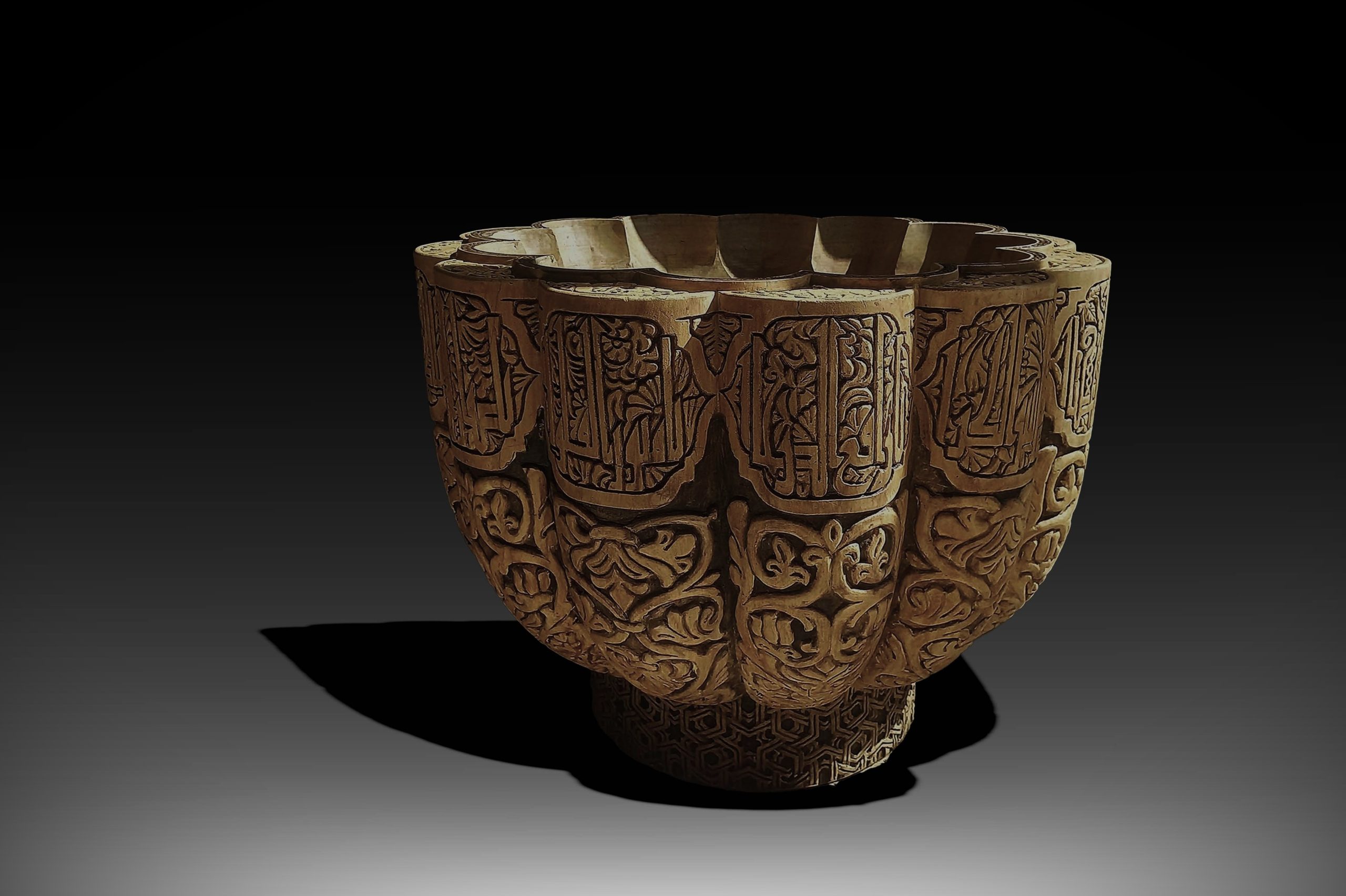
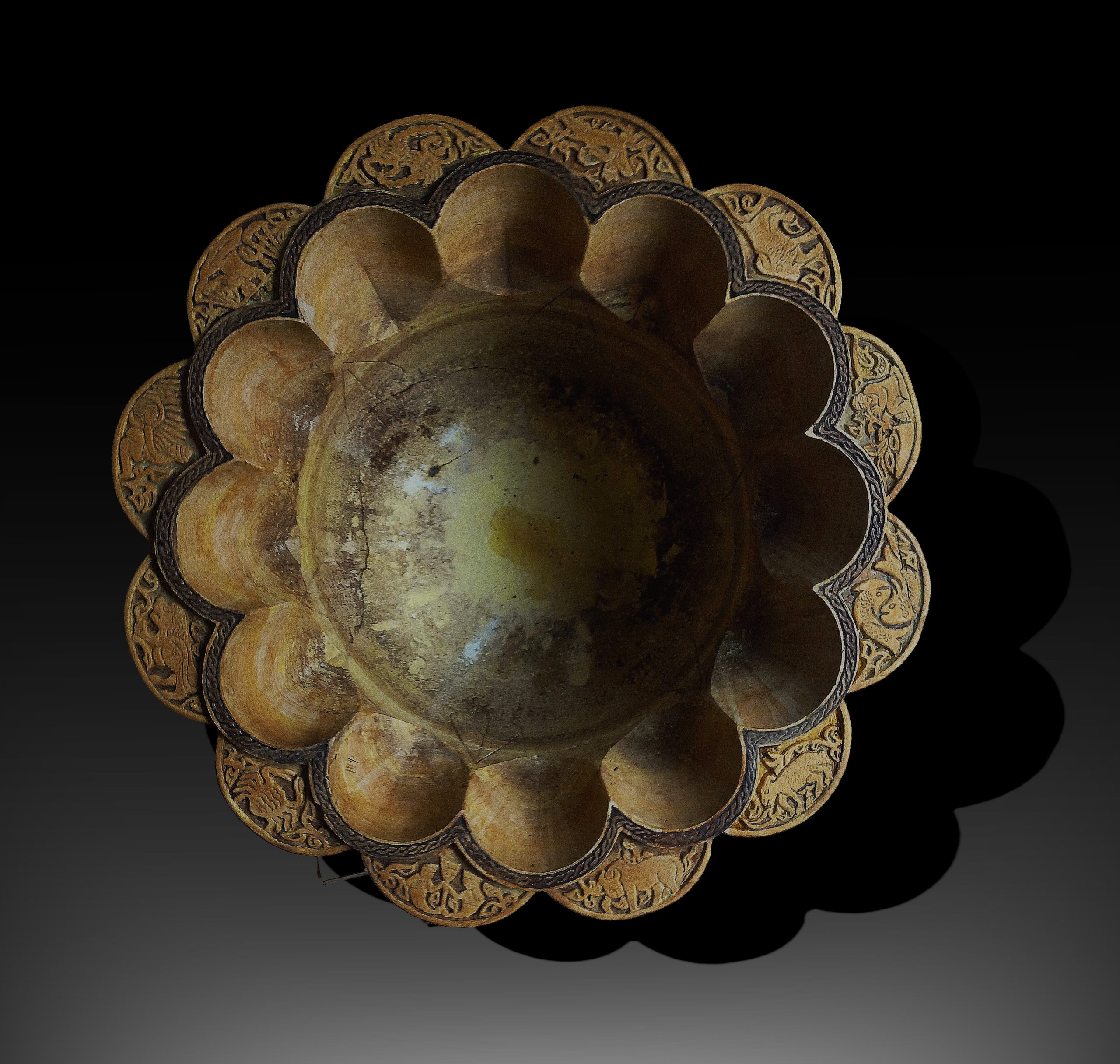
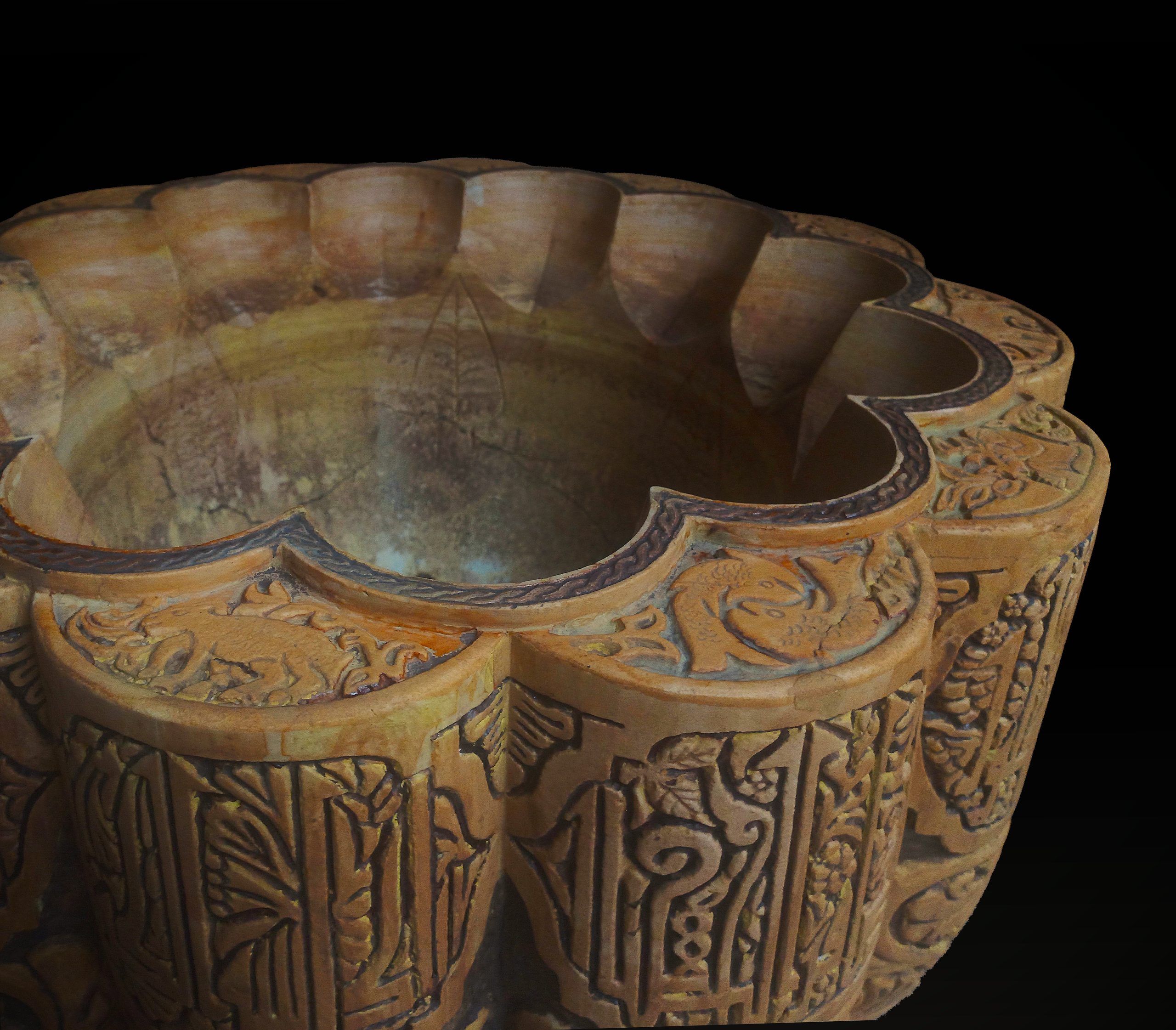
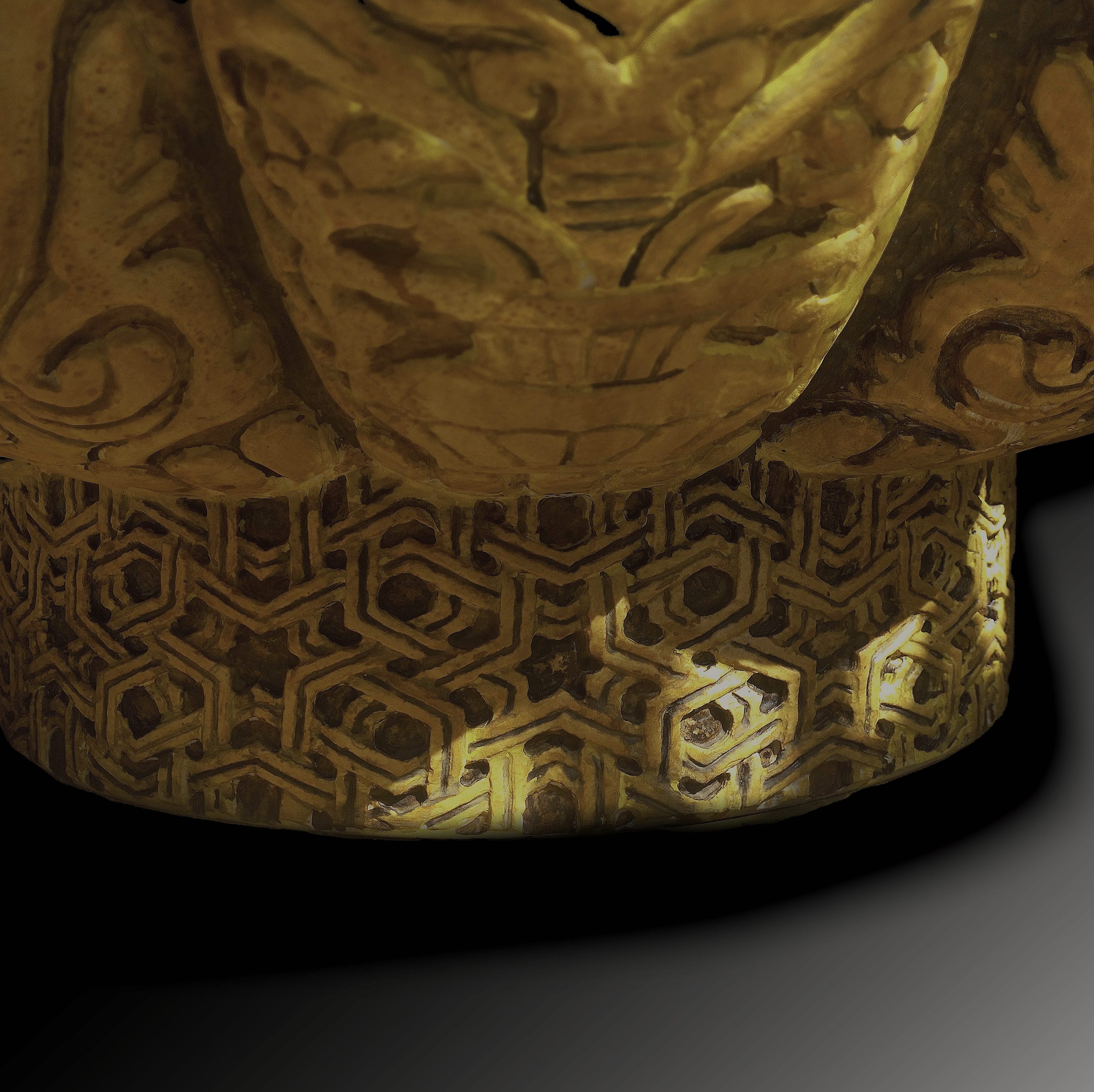
From a grandiose Islamic master stone masonry is an ancient art form defined by sacred geometry hand-carved ornamentation on this illustration the marble basin is a magnificent creation with the deep hand-carved, on a raised base and carved with the design in a geometric-patterned foot; the basin has a matte rim on the surface in a crescent shape carved deeply with the twelve Islamic zodiac symbols in relief; the upper aspects have a band of foliated and perpendicular Kufic intertwined with scrolling ground; the body has an intricate design of interlaced vines and blossoms.
FOOTNOTES:
Function: Originally the hand carved marble basin designed to stand on a pedestal or base in a mosque, courtyard, or prominent public building, where it was filled with water for ritual ablutions or in the Islamic architecture and traditional Arabic culture, a public structure or marble basin used to provide free drinking water to the public is called a Sabil (or Sebil / Sebeel). Derived from the Arabic root meaning a charitable act for the sake of God, a sabil was often built as a religious or civic charity with the waqf) in Islamic architecture to offer free drinking water to travelers, pilgrims, and passers-by.
Artistic Style:
Features deep, delicate two-level carving influenced by surviving Hellenistic, Roman, and Early Christian stonework in the region.
Decorated with intricate split-palmette arabesques, scrolling vine leaves, and rounded handles or projections.
The Al Jazira, including Aleppo, Damascus and Mosul from AD 1127 – 1250. The region was rich in remains of Hellenistic, Roman and Early Christian monuments, and in centres such as Harran during the Islamic period, earlier stone elements were often re-used and classical ornament was copied.
This particular basin would probably have once occupied a prominent position in a mosque or public building, where it would have been placed on a pedestal and filled with water. It has been suggested that the form of the present lot was based on a Byzantine capital, although no exact parallel has been found and the piece does not appear to be recarved; however, the closest comparison is a Byzantine basin with three rounded projections and a spout found in an excavation at Pyla in Cyprus in 2006.
Another example of a marble basin, from the same region, but slightly later in date, can be found in the Victoria and Albert Museum, London (Inv. 335-1903). Bearing an inscription giving the name and titles of the Ayyubid governor of Hama in Syria from AD 1244-84, al-Malik al-Mansur Muhammad ibn al-Muzaffar Mahmud ibn Muhammad ibn ‘Umar ibn Shahanshah ibn ‘Ayyub (also known as Mansur II Muhammad) and, may have adorned the courtyard of a mosque he founded. Although stylistically different, the basin contains an inscription band above a design of split-palmette interlace.
The intricately carved palmette design of this finely carved basin is typical of a style that developed under the Zangid dynasty and continued in the Ayyubid period. An architectural element in the National Museum of Damascus (A/1545/5068) illustrated in L’orient de Saladin l’art des Ayyoubides (exhibition catalogue, Paris, 2001, p. 45, no. 32) bears a similar design, as well as the triangular suspension bracket of a brass geometric table in the British Museum made in Mosul AD 1241-42 (ibid., p. 210, no. 222). It can be also be seen on the panels of an ivory and bone inlaid wood storage chest attributed to Mosul, c. AD 1240, in the David Collection, Copenhagen (von Folsach, Kjeld, Art from the World of Islamic in The David Collection, Copenhagen, 2001, p. 266-67, no. 428).
A rare example of a Zangid carved marble mihrab mihrab panel, attributed to Syria or the Jazira and to the early 13th Century bearing a similar kufic inscription to our basin as well as a very similar palmette border and scroll work, was sold at Sotheby’s (Sotheby’s, Arts of the Islamic World, 6th October 2008, Lot 136). Comparison can also be drawn with a capital attributed to the Ayyubid early 13th Century in Eastern Syria or Mesopotamia that sold a Christie’s (Christie’s, Art of the Islamic and Indian Worlds, 7th October 2008, 128). The Christie’s piece has the same net-like decoration covering the whole surface.
The scrolling vine decoration on the rounded projections can be paralleled closely with the domed terminals of two marble corner posts from a tomb in the David Collection, Copenhagen (von Folsach 2001, p. 245, no. 392). These posts also have similar kufic inscriptions with scrolling palmette vine in the background and also on the surrounding borders. This style of decoration recalls the late Samarra bevelled style found in Syria and Mesopotamia.
CONDITION REPORT:
It’s relatively acceptable condition, the surface is weathered, with abrasion and wear with ageing colour presumably hand painted, as we have decided not to peel off the hand painting, consistent with age and use, some inside scratches insignificant notches and water marks stained and encrustation, some chips to extremities, as viewed.
PROVENANCE:
PROPERTY FROM A PRIVATE COLLECTION
