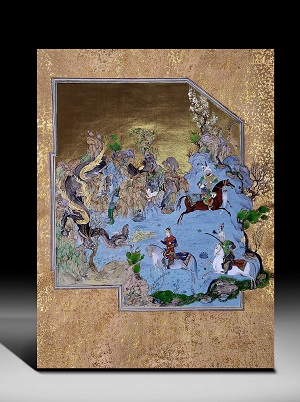
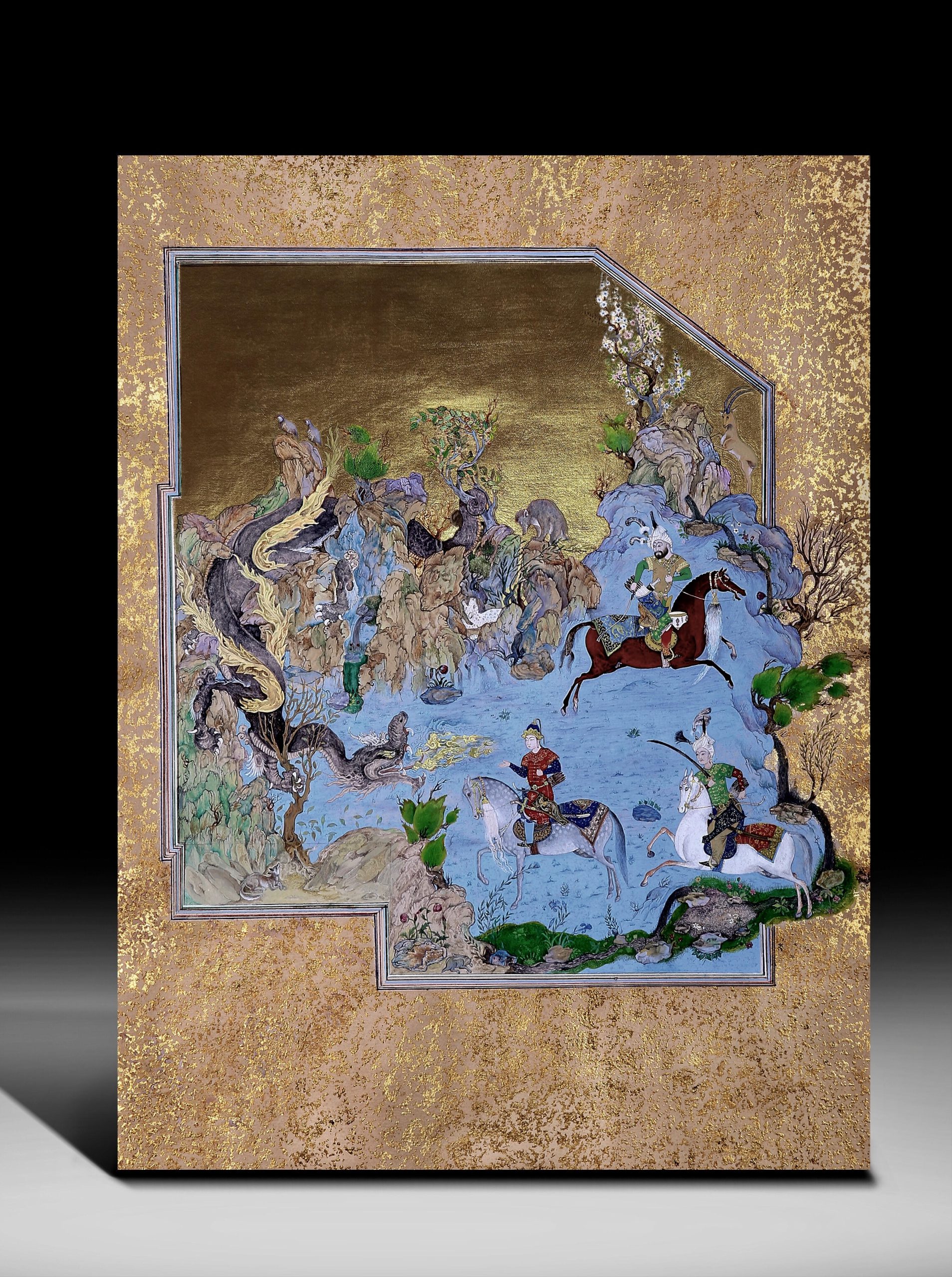
DESCRIPTION: | MATERIALS & TECHNIQUE: Paper and authentic Gold-Ink and Gold leaves. Ink, opaque watercolour and gold on paper, double inter columnar on rules in gold, wide gold-sprinkled margins.At the site of the dragon the oldest son turns and flees, exclaiming that no sane person would fight a dragon. The middle son prepares to fight the beast as if he were in battle with another man. The youngest sin stands his ground, telling the dragon to be off because he and his brother are the sons of Faridun and warriors like their father. Faridun calls the first one salm because he had sought safety; the second he names turn for his brash fearlessness; and the third, who astutely and bravery confronted the dragon, is dubbed iraj, To each Faridun assigns one-third of his kingdom,Salm receives Rum, the western provinces; Tur receives the eastern section, Turan and Iraj are given the central kingdom of Persia.The Shahnameh The Epic Of Kings:
The Shahnameh or ‘Book of Kings’ is the Persian national epic, telling the history and legends of Persia from prehistoric times down to the end of the Sassanian dynasty in the seventh century AD. The author, Firdausi (circa 933-1020), assumed the task of writing the history of the Persian kings in verse in 976 after Dakiki, a poet friend who had started the work, was murdered, Firdausi devoted the remainder of his working life to composing the 30,000 couplets of the Shahnameh. The finished text was presented to Sultan Mahmud of Ghazna in 1010 AD, 1001 years ago this year. The text was henceforth to become a touchstone of Persian royalty. The kings a confirmation of their sovereignty and a symbol of their dynastic legitimacy. From the 14th century onwards no cultured prince could ignore the obligation to commission his own illustrated version of the national epic. |
|---|