PERIOD | 11th Century |
|---|
ORIGIN | |
|---|
DIMENSIONS | (8.5 Cm) high x (18 Cm) long x wide (10.5 cm) |
|---|
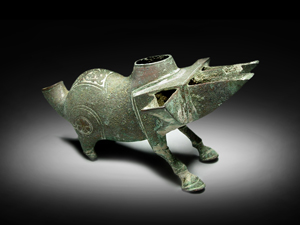
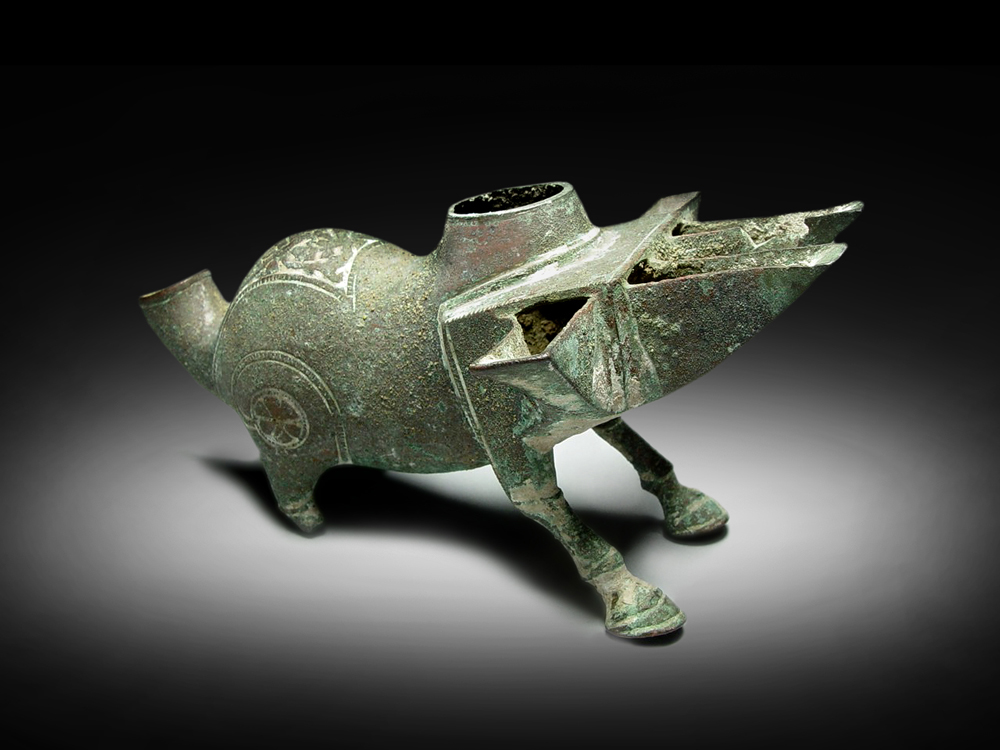
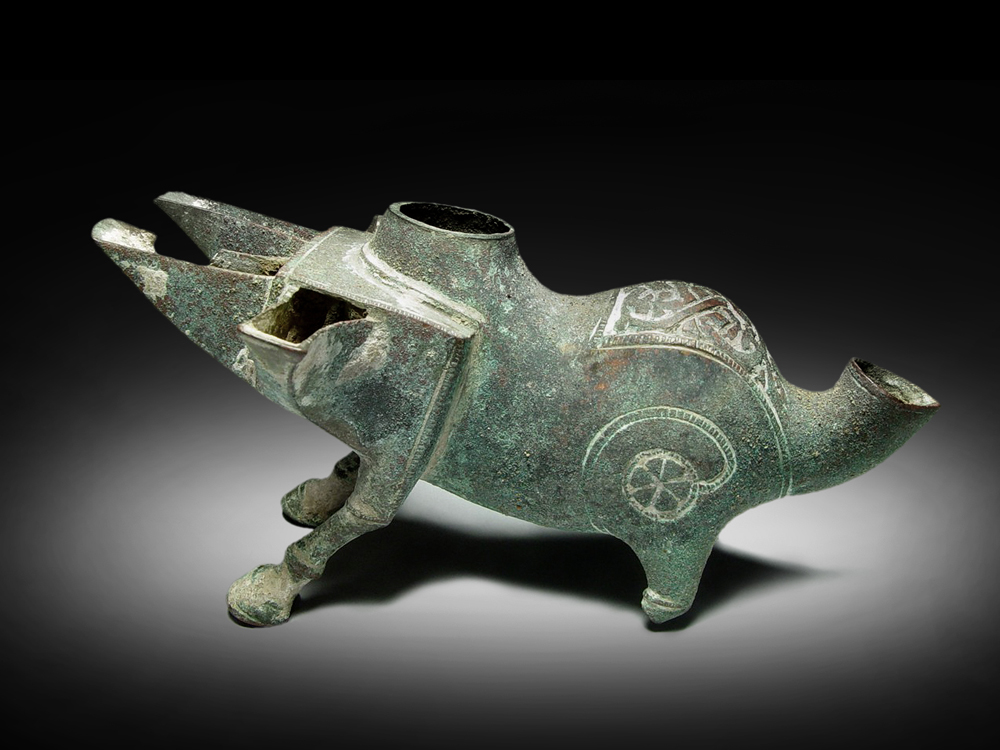
DESCRIPTION: | The Feline stylistically formed with long ears, a pronounced nose, and short recurring Tail, with two spouts issuing from the forelegs, and one beneath the tail, the back of the head.With a band of openwork geometric and palmetto design, a drop shaped hole to the back, the head separate and joined with a bayonet joint, some areas of corrosion. The majority of the surface with a rich red patina. |
|---|
FOOTNOTE: | The Seljuks were a Turkic dynasty of Central Asian nomadic origins. Having defeated the Ghaznavids in the eleventh century they took over Baghdad in 1055 A.D. At one point the empire stretched across Iran, Iraq and much of Anatolia. By the end of the eleventh century however dynastic disputes led to the division of these lands. The main branch- the so-called Great Seljuks- maintained control over Iran. This was a golden age for Islamic art typified by innovation and experimentation. In metalwork one of the most important developments was the practice of inlaying bronze or brass objects with precious metals such as copper, silver or gold. Bronze casting flourished and famous workshops were established in Khorasan and the surrounding area.Zoomorphic oil lamps are rare and highly prized by collectors. This example is cast in the shape of a feline (either a lion or a lynx) but the style is not naturalistic. Islamic law forbade anthropomorphic/zoomorphic representations but artists circumvented this restriction by the so-called “principle of improbability.” This feline is highly stylized, with hooves rather than paws and geometric motifs incised into its back. The proportions are purposefully manipulated particularly the ratio between the head and the body. The neck is pierced and the facial features are deliberately simplified, with a prominent nose and whiskers. The neck itself is hinged so that the oil can be poured into the hollow body. Most metal oil lamps from this period have just one or two spouts, so the inclusion of four, which project from the front of the feline’s body, is highly unusual. This is an extremely delicate and superbly crafted example of Islamic metalwork. |
|---|
PROVENANCE: | UK Private Collection Since 1970’s |
|---|
CERTIFICATE: | Comes with a certificate from the Art Loss Register |
|---|