


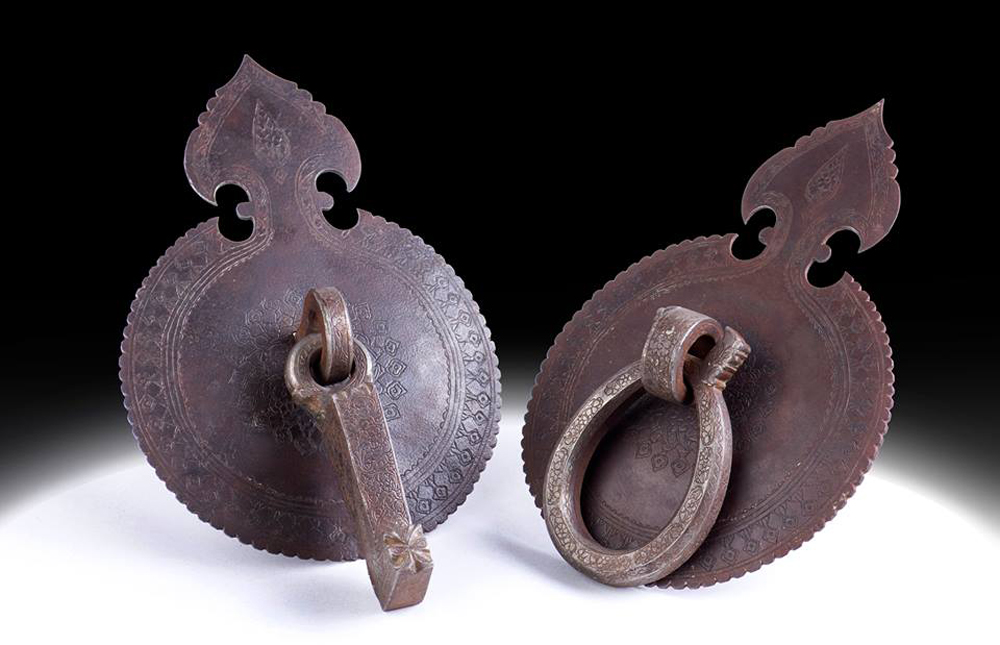
A RARE PAIR OF YAZD DOOR KNOCKERS
PERIOD | 17th Century |
|---|---|
ORIGIN | Yazd city Persia |
DIMENSIONS | Bakplate, 30-Cm x Knockers 15-Cm |
DESCRIPTION: | This Set Of Door Knockers came from a door an Historical House in Yazd & each. Shaped With a Crown Head Formed & The BackPlate in The Central Engraved with a Single “Persian Cypress Tree” Openwork Pendant with Arabesques attached to a Central Rod with The Overlaid Decorations & Parlance Flora & Foliage’s. |
FOOTNOTES: | Indigenous inventionWhile wandering into the historical architectural places of Iran, you will probably be struck by the beauty of the old wooden doors, in narrow streets and alleys. At first look, you might not notice it, but if you pay close attention, you will find a characteristic feature which offers great insights into the Iranian culture. Two different shapes and soundsOn all traditional entrance doors, Iranians used to place two types of handmade doors knockers (Kubeh) with different shapes and sounds. Usually on the left side, is a thick bar of metal, producing a deep tone, while on the right side is a metal ring that makes a lighter sound. Have you guessed the purpose of these two knockers? By producing two different and distinct sounds, the lockers are intended to indicate to the host which the gender of the guest is. Men must knock using the deep tone metal bar on the left, while women use the metal ring on the right. This way, the host would know before opening the door if a man or a woman is about to enter and dress up accordingly. A sign for the woman hostIndeed, according to Islamic customs, women must cover their hair while in public. It tends to be less common today, but in the past, a large number of women also used to cover entirely by wearing a chador. However, inside their house and in front of their family and relatives who are called “Mahram” in Islamic culture, women don’t need to cover themselves up. Thus, when a guest arrived at the door, the women of the house could know how they had to dress simply by hearing the sound of the knocker. If a man was knocking at the door, indoor ladies knew by the sound of the “Kubeh”. Yet, if the light tone of the women knockers was heard, she didn’t have to cover herself. Nowadays, this ancient architectural element is no longer used but beautiful examples can be seen in old parts of each city, town or village in Iran. |
CERTIFICATE: | Comes with a certificate from the Art Loss Register. |
